
Laplace’s Demon haunts me.
This demon was conjured into existence by a Frenchman to show the deterministic nature of the world. It knows all of the locations of all the smallest particles, it knows of all the laws of physics, and it has godly powers of calculation. The demon can work forward or backward from his knowledge of the state of things, because the universe is mechanistic and deterministic.
If you prefer a more modern example, this is Devs, from that show, Devs. That show concerns a quantum computing giant, Amaya, and a secretive team that creates a computerized incantation of the Demon. In one memorable scene, the Devs team tunes their machine one second into their future. They see themselves watching themselves, repeating their own actions from the screen as a creeping horror dawns over them. “Uh-oh,” concludes one of the programmers.
Another example is from Ted Chiang’s Exhalation, a delightful collection of mind-bending short stories. In “What is Expected of Us”, there exists a small device called a ‘Predictor’. It has one button and a light that flashes green. You press the button and the light flashes green. But due to some timey-wimey wibbly-wobbliness, the light flashes green one second before you press the button. Despite the best effort of those who play with the device, the light flashes green, and the button is always pressed. It must be pressed.
Both of these science fiction scenarios and Laplace’s Demon are meant to show that the world is, in essence, understandable; predictable. If we had perfect knowledge, we would be able to make perfect predictions forward or backward, rewinding the tape to the Big Bang or fast-forwarding it to the heat death of the universe. And being trapped on that roller coaster causes a unique kind of horror to the human mind. Many people in the scientific, materialist West will agree that there is no place for free will in the systems as we understand them. But nobody can live that way. We deny that reality, or maybe more accurately, our brain protects us from that knowledge by forgetting about it, hiding it with an incredibly effective illusion of free will from within our subjective experience. It is something we can understand intellectually, but we do not confront it viscerally. Indeed, in Chiang’s short story, when the Predictor forces such a visceral confrontation, something like a third of the users fall into a waking coma:
“Before people started playing with Predictors, akinetic mutism was very rare, a result of damage to the anterior cingulate region of the brain. Now it spreads like a cognitive plague. People used to speculate about a thought that destroys the thinker, some unspeakable Lovecraftian horror, or a Gödel sentence that crashes the human logical system. It turns out that the disabling thought is one that we've all encountered: the idea that free will doesn't exist. It just wasn't harmful until you believed it.” – Ted Chiang, “What is Expected of Us”
All of these stories highlight the horror of perfect prediction of an understandable universe, and they are all worth puzzling over and reckoning with. But as we all know, I am not good at prediction, and lately I have been wondering about something else. What about the horror of not being able to predict anything at all? Enter another science fiction luminary, Cixin Liu, and The Three Body Problem.
The Three Body Problem starts with a mystery: all over the world, scientists have begun killing themselves. It seems as though they have reached the limits of their science and see that it is impossible to move forward, and have, in despair, taken their own lives. The titular three-body problem is central: it is possible – trivial, even – to predict a system with two variables. We can easily chart the path of the Sun and the Earth. But when even just one more variable is introduced, the system becomes chaotic, it becomes impossible to predict.
I thought this was one of the coolest science fiction concepts I had ever encountered. Imagine, a group of the smartest people on the planet, determined to understand the world, only to come face-to-face with the realization that they cannot understand or solve a problem with three variables. Like the Predictor but in the opposite direction: instead of viscerally understanding that your world is understandable, you come to understand that the world cannot be understood, and that any attempts to do so are folly. And similar to the Predictor’s akinetic mutism, the realization was a cognitive hazard, and a terminal one.
Now, I didn’t love where the novel went with this – it ends up being aliens with super advanced technology that makes all scientific progress impossible, rather than the impossibility of understanding being baked into the nature of reality. I think that this was kind of lame. It turned what I thought was a fascinating philosophical thriller into a fairly bog-standard First Contact story. Now, Cixin Liu is one of the world’s best sci fi writers and I’m just a chump with a blog, so who’s to say what was right or wrong. But the set up, and the idea of investigating the universe only to discover how dreadful it is – that has always stuck with me.
Maybe it has to do with my education. At Santa Clara University, I took a class on Nietzsche with Dr. Philip J. Kain, several years after he published Nietzsche and the Horror of Existence. And look, I am not going to talk a lot about Nietzsche. I am sorry, Dr. Kain, I don’t love Nietzsche all that much and never really did[1]. I jettisoned a lot it as soon as I passed the class. But there was one idea that, like the set up from The Three Body Problem, has stayed with me for a long time. What I remember most from these classes was Dr. Kain’s insistence that key to understanding Nietzsche was the understanding of the Horrific Cosmos.
Nietzsche, Dr. Kain asserted, lived in a Horrific Cosmos. To understand what that means, it may help to contrast it with other potential types of cosmos (cosmes?): the Ordered Cosmos and the Perfectible Cosmos.
The Ordered Cosmos is a world that is built for us. It was meant for us to live in it, to thrive, to understand it and ourselves. God created the universe for his beloved children, so that we could come to know our world, ourselves, and our Creator. We fit in this Cosmos like a jigsaw piece into a larger puzzle, and it makes a beautiful picture. This is, to my mind, baby-brained shit. There is no evidence to support it and overwhelming evidence against it. The sun gives us cancer. If this was created for us, it was by a dipshit god[2].
So maybe it is a Perfectible Cosmos. It is a Cosmos that is maybe not made for us, but it is a universe that we are able to understand. It follows certain predictable and comprehensible rules. Through diligent study and practice, we can come to some degree of knowledge of the workings of the universe, and we can make ourselves a home in this universe. To me, this is plausible, if a bit underwhelming. Goldilocks-ass, middle of the road understanding of the universe. Boring. Bring me something interesting. Something spooky. Bring me a Horrific Universe.
The Horrific Universe is a universe that is indifferent or outright hostile to humanities place in it. It cannot be understood by our feeble intellects, and we are deluding ourselves when we even attempt to try. We are not meant for this universe, we are simply an accident of probability with no greater meaning or purpose. Humanity will die trembling on a rock floating in a vast emptiness and nothing and nobody will notice. Our crude monkey minds are not up to the challenge of changing the universe and making it anything but a yawning cosmic void. Any progress we make is illusory, and if it looks like there is progress it is only an artifact of our limited perspective; it is only because we are too small and stupid to realize how big and indifferent and weird the Cosmos actually is.
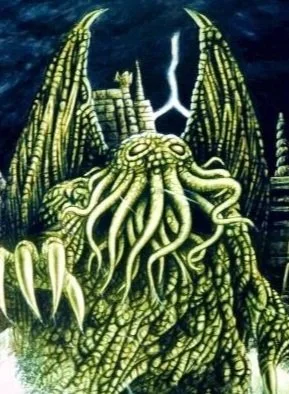
When Dr. Kain told us about the Horrific Cosmos, I understood it immediately: It’s “The Call of Cthulhu.”
“The most merciful thing in the world, I think, is the inability of the human mind to correlate all its contents. We live on a placid island of ignorance in the midst of black seas of infinity, and it was not meant that we should voyage far. The sciences, each straining in its own direction, have hitherto harmed us little; but some day the piecing together of dissociated knowledge will open up such terrifying vistas of reality, and of our frightful position therein, that we shall either go mad from the revelation or flee from the deadly light into the peace and safety of a new dark age.” – H.P. Lovecraft, “The Call of Cthulhu”
So goes one of the hardest openings in all of fiction. And honestly, I can’t explain it any better than that. You don’t even need inscrutable Eldritch Gods to make it horrifying[3], the idea alone is enough to send shivers up my spine. We think of trying to understand our world as inherently noble and fulfilling, an end in itself. The Horrific Universe turns that on its head – what if, in learning about the true nature of reality, we learn the despairing truth of our limitations? What if we can’t understand the universe? What if what we learn is something we shouldn’t?
I don’t know if we live in a Horrific Cosmos or a Perfectible one. I am pretty certain we do not live in an Ordered Universe. We began this exploration with Laplace’s Demon and the horror of things being perfectly explainable, and predictable. It is also possible that the cosmos is a vast, yowling monster, where nothing can be learned, or at least, nothing good. Which of those frightens you more? Is the tyranny of order preferable to a chaotic indifference? I know which one keeps me up at night, looking up at the stars, searching for an answer I shouldn’t be trying to find.
[1] I’m into philosophy but not that kind of edgelord philosophy. I like earnest, sappy shit like virtue ethics.
[2] ‘Dipshit God’ is also a top-notch thought experiment, but that’s a subject for another paper, I think.
[3] Don’t get me wrong, I enjoy that the horrible eldritch things are there, too. I can get down. Give me a big old smooch with those tentacle lips baby.